
How Roof Coating Extends a Commercial Flat Roof — The Short Answer
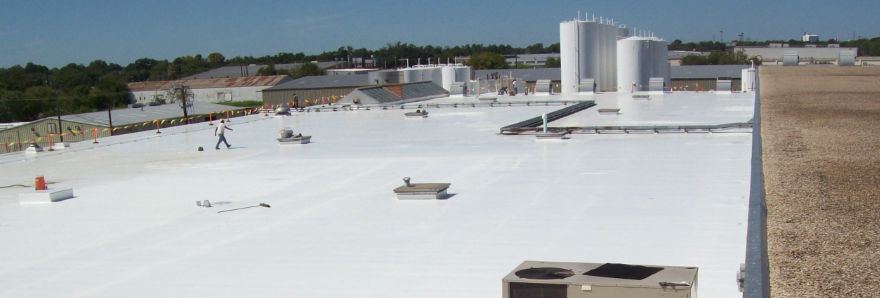
What has to be documented on a roof coating in the Harbor Area before you call a carrier, and in what order.
An insurance claim on a roof coating is won or lost on documentation, not on argument. In the Harbor Area, this is what needs to exist before anybody calls a carrier.
What actually matters
A coating is a renewal of a roof that still works, not a repair of one that does not. Applied to the right substrate it can add years for a fraction of a tear-off; applied to the wrong one it seals a problem inside. For a claim that means the damage has to be described in terms of the system, not the surface.
Where claims go wrong
Claims are lost on scope far more often than on liability. Every affected element needs identifying at the start, because adding it later means a supplement and fresh evidence. Wet film thickness is the number that matters. It is measured during application with a simple gauge, and it is the only way to know the roof is getting the millage that was quoted rather than a thinner coat spread further. Almost every difficult claim we see went wrong in the first week.
What is specific to the Harbor Area
Humidity stays high, salt is constant, and industrial fallout settles on top of both. Flat and low-slope roofs dominate the commercial stock here, and a membrane that would give twenty years in a dry inland setting can give noticeably less with that combination working on it every day. Much of the building stock is older commercial and industrial with large low-slope areas, parapets, and rooftop plant that gets walked on regularly.
What we look at on an inspection
- Substrate moisture, established before anything is quoted
- Adhesion, confirmed by test patch rather than assumed
- Surface contamination, chalking and existing coating compatibility
- Seam and penetration reinforcement requirements across the roof
- Ponding areas, which need drainage correction before coating
- Wet film thickness recorded during application
- Manufacturer specification for the substrate actually present
Common questions
Why do claims get denied?
Most often because the damage cannot be tied to a dated event, so it reads as wear and tear. Wear and tear is not covered by any policy.
Should I get my own assessment as well?
It helps. An itemised independent scope gives you something concrete to discuss if the initial approval misses elements.
The honest summary
A coating over a sound, dry, properly prepared roof is one of the best-value things available. Over wet insulation it is money spent trapping the problem where nobody can see it. In the Harbor Area the thing to watch is membrane condition around rooftop plant, parapet terminations, and every drain and scupper on the roof.
Free inspection, drone photography where access is difficult, and a written estimate with deck repair priced per sheet. No obligation.